

Introduction:
The manufacture of glass containers represents one of the most challenging manufacturing industries globally. Requiring lubrication throughout, from shear sprays, delivery lubricants and coatings to mould swabbing compounds and machine lubricants.
Operating at high temperatures, high speeds, and with the sheer pressure of production, it is critical for lubricants to endure extreme conditions, reducing friction and wear.
These conditions require manufacturers in the glass industry to invest in high-performance, specialist solutions to meet rising demand and reduce consumption/production waste.
During Molyslip’s most recent case study, a prominent glass manufacturer in Western Europe operating from two high-capacity manufacturing plants consulted our technical team to find a solution to reduce lubricant consumption by extending lubrication intervals.
Issues
During production, the manufacturer encountered issues with lubricant leakage and overconsumption due to extreme heat and the precision requirements needed to ensure product quality.
Key processes occur during glass production, each with unique challenges and operational conditions to consider.
Poor lubrication can lead to issues, such as bubbling, blistering and check cracks. These issues result in poor quality glass and higher rejection rates.
A thermally stable lubricant is vital at this stage as temperatures up to 200°C are encountered; without lubrication, the moving parts would quickly fail, linkages would wear, and the metal-on-metal contact would cause seizing.
The manufacturer was operating a 1.5M glass bottle capacity facility running out of 3, 12-section IS machines.
When our team was invited to review the manufacturer’s current issues, it was noted that the current lubricant was experiencing significant waste and leaks, with oil and lubricant pooling around the machine parts where lubrication was applied.
Other common issues include high consumption, both in lubricant and energy. Reducing both issues can help align with sustainability goals, as reduced consumption across the board can reduce the ecological impact of production.
This is a common issue for modern manufacturers who are looking to align their business with a more eco-aware industry and wider customer expectations for sustainable practices.
Solution
When Molyslip’s technical team were looking to meet the manufacturer’s requirements, our technical support team worked alongside the factory team and the IS maintenance manager to assess their specific requirements and manufacturing goals.
After a detailed review process, Molyslip’s technical team identified Glasstek IX-220 UV as the optimal solution to meet these manufacturing goals.
Glasstek IX-220 UV excels by offering following key solutions to common manufacturing issues:

Prior to the implementation of our product, our technical team conducted a series of lab tests against the competitor products, proving the superior performance of Glass IX-220 UV over the incumbent product.
Viscosity test:
During viscosity testing, we aimed to measure the viscosity of both lubricants at operating conditions (210°C) over time. For glass manufacture, a consistent, low viscosity is vital for smooth production.
When testing, a dramatic increase in viscosity is a bad sign for production, as high viscosity lubricants don’t flow well, are sticky, and can attract dirt, leading to increased friction and wear. Lubricants must remain low viscosity as they age. This can all lead to increased maintenance and downtime as parts needs to be replaced.
Highlighted in the test results below, we see the stability of Glasstek’s viscosity over an 8-hour testing period.
Glasstek IX-220 UV exceeded the results, remaining almost completely stable throughout the testing phase, whereas the competitor’s product eventually began to break down after 4 hours.
Thermogravimetric Analysis (TGA):
Another way that the thermal stability of a lubricant can be measured is through Thermogravimetric Analysis (TGA). During the TGA test, a small sample of oil is heated to 210°C for 1 hour. The mass of the sample is measured during the test.
As the lubricant is placed at operating conditions, it loses mass as the lubricant evaporates.
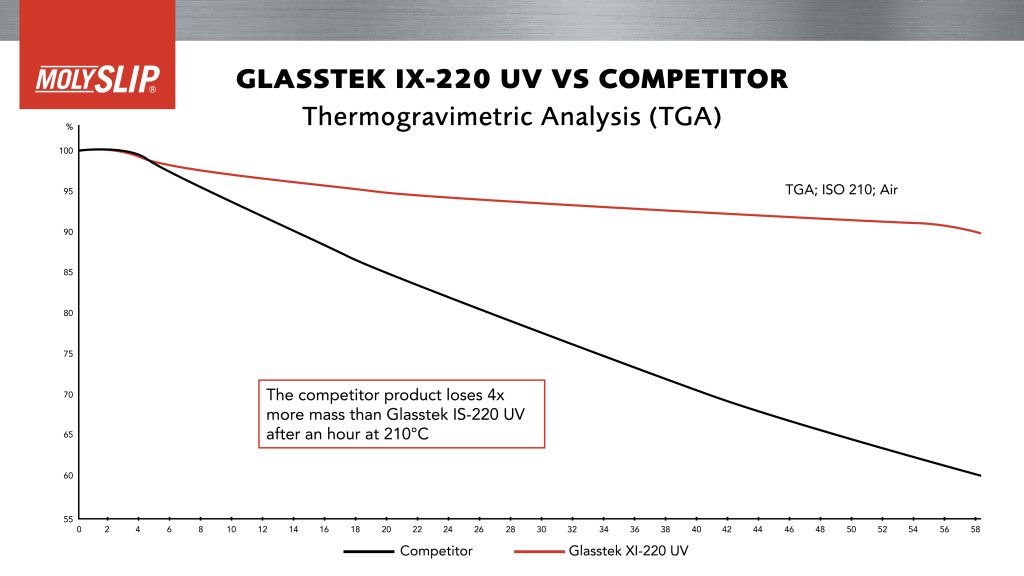
As the graphs show, we see that Glasstek IX-220 UV maintains its mass smoothly over time. This is in stark comparison to the competition, which saw a consistent and steep drop in mass, losing 4x its mass compared to Glasstek IX-220 UV when put to the test.
It’s due to these key advancements that IX 220 UV was considered the most effective lubricant to reduce consumption.
Resolution
After a three-month trial period using Glasstek IX-220 UV, the manufacturer saw some staggering results.
By adopting Glasstek IX-220 UV, the manufacturer doubled re-lubrication intervals.
This saw a difference from intervals every 25 minutes up to 48 minutes, doubling the intervals and production time. This led to increased productivity within the glass plant and reduced operating costs for the manufacturer.
Utilising Glasstek IX-220 UV also gave the operator our unique UV leak detection system, meaning that any lubricant leaks could be easily highlighted, allowing for quick action in remedying potential leaks in the future.
The glass manufacturer was so impressed with the results that Glasstek IX-220 UV was utilised at both of its manufacturing plants, with a comparable rollout at their second manufacturing plant, delivering similarly stellar results across both wings of their production.
Conclusion
This case study highlights the production-changing results manufacturers can look to achieve by utilising this exciting new glass lubrication range.
The Glasstek range offers a complete revolution to the glass manufacturing industry. Each product is formulated to meet the unique challenges of glass production, ensuring optimal efficiency and superior machine performance.
Molyslip’s extensive range of lubricants has been expertly developed to address every key application in glass manufacturing, providing reliable, long-term solutions.
Some of our other glass industry solutions include:
- EGC Range: Our resin bonded graphite delivery coatings provide a thermal barrier, offering essential lubrication between the semi-molten glass gob and key components such as deflectors, troughs, and older machinery scoops.
- Glasstek SL-40: This shear spray lubricant protects shear blades from oxidation and wear during production, helping to maintain performance and extend the lifespan of critical components.
- Molyslip® DL Range: Specifically designed for gob distributor systems in high-volume glass container manufacturing plants, our scoop oils ensure smooth, reliable lubrication.
- Glasstek IS Range: A premium lubrication solution for I.S (Individual Section) machines, ensuring consistent lubrication and performance throughout production cycles.
- Glasstek AG-20: A water-based graphite lubricant designed for conveyor belts during transfer coating, ensuring reliable lubrication while minimising container rejects.
For more information on how the Glasstek range can deliver results like this for your production, get in touch with our sales team today to discuss the entire range.
 English
  Spanish (Spain)
  Spanish (Mexico)
  French (France)
  French (Canada)
  French (Belgium)
  Portuguese
  German
  Italian
  Arabic
  Chinese